Above Lake Dunstan, with views stretching across the Pisa Mountain range and the Dunstan Mountains, Fortune Fruit has carved out a reputation as one of Central Otago’s most efficient and quietly successful cherry operations.
The orchard was established in the late 1990s by grower Hugh Dendy, who brought years of cherry growing experience with him when he moved to New Zealand from Canada. What began as a bare block has developed into a mature and well organised orchard supported by a new generation of plantings at Clyde and a team that values precision and hard work.
Part of Hugh’s early vision when he purchased the Sugarloaf property was to operate in both hemispheres, giving the business the ability to manage two cherry harvests each year.
While he now exclusively focuses on his New Zealand operation, it was that thinking that set the foundations for what Fortune Fruit has become today.
The Lowburn site covers 42 hectares, almost all of which is mature production with a further 25 hectares of young trees at Clyde. Across the two properties, Fortune Fruit grows nine cherry varieties throughout the season, beginning in mid December with early maturing varieties Santina and Sonnet, finishing in early February with Staccato.
Although the orchard grows a small volume of apricots, the business is almost entirely focused on cherries. This supports its reputation for efficiency, something General Manager Blair Davidson sees as central to their success.
“Cost drives a lot of our thinking,” says Blair. “The cost of running a place like this has increased over the last decade, especially since Covid. So, we have to be smarter about how we do things. We need to do more with fewer people, and we need to hold on to good staff.”
That focus on efficiency shapes the orchard as much as it shapes the packhouse. One of the practices that sets Fortune Fruit apart is strip picking, a method Hugh brought with him from Canada. Rather than selective picking, the team picks everything on the tree once it is ready, then lets the packhouse Fachaux cherry cluster separator and RedPearl grader do the sorting.
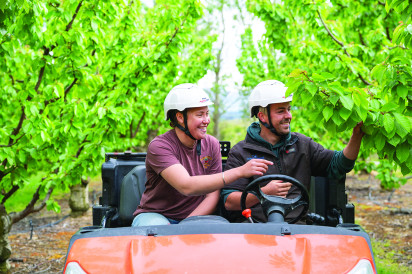
“No one did strip picking in New Zealand at the time,” Blair says. “It was just what Hugh had always done. It is becoming more common now, especially with labour shortages during Covid. It allows good volumes to come off the trees quickly, and the grading technology handles the detailed sorting.”
The approach works because the orchard is pruned heavily to allow light into the canopy, lifting fruit size and firmness. The consistency of the growing and pruning systems makes strip picking a viable part of the overall operation rather than a shortcut, and the packhouse technology has also played an important role in supporting the practice.
Fortune Fruit has invested in a Red Pearl Optical Grader that scans each cherry and sorts for size and quality with a level of precision that manual sorting simply could not achieve. The combination of pruning, an efficient team of pickers and accurate grading makes the system more streamlined and allows them to focus on managing crop flow rather than labour bottlenecks.
While efficiency is a defining feature, Fortune Fruit is equally known for the quality of its team and work environment. The team is known for being friendly and tight knit, reflecting the family nature of the orchard.
“We want to see people move forward in life,” he says. “We are not interested in holding anyone back. We want them to develop, get skills and do well, whether they stay with us or go somewhere else. It is better for the individual and it is better for the industry.”
The partnership with MG is an important part of Fortune Fruit’s business model. MG handles the domestic cherries, providing reliable placement into key markets throughout New Zealand. Fortune Fruit also works with MG subsidiary business, Te Mata Exports as an export partner.
“MG plays a vital role in selling the domestic cherries,” Blair says. “It can be easy to overlook how important the domestic market is, but it is a significant part of our operation. The team at MG have always done a very good job for us and we value that partnership.”
Looking ahead, Blair takes a pragmatic view. The orchard will continue to grow, adapt to seasonal challenges and look for opportunities to refine the system further. Climate variability brings uncertainty, but he sees the answer in continual improvement rather than dramatic shifts in direction.
“Every season is different,” he says. “You do everything you can to prepare, but the weather will do what it does. If you hold on to that too much, your health would suffer. So we keep moving forward and we focus on doing everything we can to grow better cherries each year, and hope that the weather plays its part in achieving this.”